Wednesday, 15 May 2019

Right To Freedom of Expression


Right to freedom of expression and freedom of opinion are among the most fundamental rights in a democratic republic . The prerequisite for a political system to run in a democratic way is to provide its citizens with the power to form their opinion on certain issues and express their views unhindered, unfettered by the fear of retribution. It allows people of the country to freely engage in the social, cultural as well as political affairs. In India, this right, the right to freedom of expression is protected under the Article 19(1)(a) and is fundamental to our democracy. However Article 19 (2) imposes certain reasonable restrictions on all the fundamental rights constituting that of freedom of speech and expression.

This right available solely for the citizens of India, not for the citizens of other country. The restrictions imposed with respect to this fundamental right are in the interest of the sovereignty and integrity of India, protection of the republic, cooperative relationships with foreign states, public order, decorum and morality and contempt of court, defamation and stimulation of an offence. The people of India declare their solemn resolve to secure to all the citizens, liberty of thought and expression in the Preamble to the Constitution of India.

At the same time, a law punishing statement made with the deliberate intention to hurt the cultural, religious or sentimental feelings of any class of people is necessary because it imposes a restriction on the right of free speech in the interest of public order. For the speech or expression that has tendency to lead to a breach of the peace or to create public disorder, there must be sound and proper nexus or link between the restrictions and the attainment of public order.

Freedom of expression is a basic requirement that should be fulfilled by every civil society. But, in this age of modernization, this right is just not limited to expressing one's views through words but it also includes circulating one's views in writing or through audiovisual instrumentalities, through advertisements and through any other communication channel. It incorporates the right of information, and freedom of the press as well. Freedom of speech and expression is like a buttress to a democratic government and should be regarded as the first condition of liberty.  

Saturday, 30 June 2018

Government versus Police


 It always be seen that whenever there is tussle between the Govt. and Police administration of any society, it is always painful for the poor people of that society. Now, what happening in USA under the Trump's administration is really brutal. The anguished cry of little babies when these little kids saw their mothers handcuffed can really make someone feelings disheartened. This ultimately led to the 'Criminalisation of Poverty'. Poor people are subjected to rigorous and often brutal circumstances and end up committing acts over which they may not have full control. If the government and police system are permanently at war with that, most poor will end up in prisons. Both India and America to some extent show the behavior of 'Criminalisation of Poverty'.

An unending mission :- 

Since 1947, India has failed to eradicate poverty despite the consistent growth in the years of 1947 till now. It is also true that poverty remains but it has lessened. Poverty varies across different States as highest in Bihar and lowest in Punjab as per 2004 records. The main brunt of poverty is borne by landless agricultural laborers, small and marginal farmers and urban poors.

Reasons for Criminalisation of poverty

The problem of poverty has been further compounded by existence of glaring inequality, social and economic outlook of any nation. What happens now under the Trump's 'Zero Toleration Policy' could also be seen in the Indian post colonial era which led some criminals group of MP, Bihar and Rajasthan. Naxalites could also be taken as the best example of it. Some possible reasons for criminalisation of poverty could be
(a) Lack of third mile connectivity
(b) Maldistribution of incomes, opportunities and powers
(c) Unbalance social and class structure of economy
Hence, with the onset of liberalized economy and development on the basis of animal spirit of capitalists, inequality of wealth or gender gap will likely to grow. This is the right time to reverse its trend whether it is Indian administration or USA administration.

Solutions

(a) Better policies with best implementation management.
(b) Growing awareness among the peoples especially the poor section group.
(c) High growth and development.
(d) Better quality of life.

Image is subject of copyright and related to http://www.rioonwatch.org/?p=30636

Monday, 14 August 2017

1971 War

This is the story of a National Hero to whom no body knows too much about him. On the eve of this Independence Day, I just want to share a story from the battle ground of 1971 India-Pakistan War.
A story which I thought that everybody should knows, a story which has to be taught in School books, a story of a young man who is really a daring person.

                                        _____________________________________________


3rd December 1971

This was the date of official declaration of 1971 war between India and Pakistan. Pakistan's fighter jet planes had attacked on Indian borders. A very young, handsome person had just joined the Indian Army in 1967 at the age of 17. He joined NDA (National Defence Academy) in 1967. He was in under training in 17 Poona Horse where the fighter jets of Pakistan had attacked. 
He did not want to leave this opportunity and wanted to become a part of this war. For this he applied for special permission to the top official authorities. He was still under training. The top authorities accepted his demand and allow him to join the battlefields but on one condition. He has to proved that he was perfectly trained and ready for this war. He gave all his test regarding his permission and passed. He joined his battalion in Shakargarh sector of Punjab as the 2nd lieutenant in command at the age of 21.

                                    _________________________________________________


Shakargarh Tehsil is situated on the border of India and Pakistan. It is the most strategic locations for Armies because it is the only single road which leads from Punjab to Jammu Kashmir. It is the fastest route to reach J&K. In 1947, our Indian Army take this route to reach J&K and liberate the Srinagar from the terrorist of Pakistan.  The war of 1971 was on its peak. The intelligence reports tells Indian Authorities that Pakistanis wants to attack on Shakargarh sector and cut the Kashmir from rest of India.

                                ____________________________________________________

Indian Army make their plans after getting this information. They make a full proof plan- 
  • Make a bridge over the Basantar river which is tributary of Ravi and flows between the two countries.
  • Clear the land mines
  • Take all the Poona Horse tanks safely in the enemy zone
  • Make a surprise attack on enemy in his zone

They work as per their plan. But when they were clear the landmines, the Pakistan 13 lancer had attacked. In that hurry-skurry situation, only three tanks had crossed the bridge. Rest were remains in Indian zone. These three tanks were now in front of the 14 T-55 tanks of Pakistan. The fight was really hard for them.

                                        ________________________________________________


These three tanks were manned by 
  1. Captain V Malhotra
  2. Lt. Avtar Singh Ahlawat
  3. 2nd Lt. in command
All these three decided not to look back and took all these 14 tanks of Pakistan head on. The fight had just start.

                                  __________________________________________________

Battle of 14 v/s 3

All set go and within some time 3 Pakistani tanks were destroyed. All three Indian tanks played well at the initial phase of fight. No chance for the opposition. Now the battle was between  11 v/s 3.
Captain's gun gave in and he retaliate. Another one down from Pakistan's side. Within some moments 4 more tanks were destroyed.
Now the fight was between 7 v/s 3
Suddenly Captain Malhotra gave up and he retreat in Indian zone. Now it becomes 7 v/s 2.
Lt. Ahlawat take them head on. But a shell hit him. He was forced to retreat. Meanwhile 3 Pakistani Tanks were destroyed. Now the battle becomes 4 v/s 1.
Remaining tanks were manned by our 2nd Lt. in command. He decided to take them head on. But a shell again hit his tank. His tank was on fire and he badly injured. He got a message from his field commander to abandon the fight and retreat. And he said-
''No Sir! I will not leave my tank. My main gun is still active and i take those bastards head on''

He keep going and he destroyed two Pakistani tanks. Now this was become 2 v/s 1. 
He point his aim and took his shot and hit the rest two. The crew of those tanks ran away from battleground. There was no indication from Pakistani commander. Suddenly the atmosphere becomes silent. With this silence, the battle was over and India took their winning shot from our 2nd Lt. in command.

                              ________________________________________________


Our 2nd Lt. still remains in his tank. He had been taken out from his burning tank by the help of other soldiers. He doesn't looks good. His face was totally burnt. His fingers had melted. He can't even speak properly. He gave the indications of some water. His mates gave them water. He had been taken towards hospital. He definitely won the battle and also definitely lost his life at the age of 21.
After the few hours of his death, news came that Pakistan had surrendered and declared a unilateral ceasefire. India wins.

                                    __________________________________________________

Who is he??

He is none other than ''Arun Khetrapal"- the unsung heroes of Indian Army who lost his life, but wins his dream. He is who which desperately give something to his country - not by words but by action. He is who which most of us doesn't listen his name. He is who that didn't want any credit, any medals and any kind of appraisal. He is who  which always inspire me.
 
2nd Lt. Arun Khetrapal who became the youngest awardee of ParamVir Chakra (later recorded by Subedar Yogendra Singh during Kargil War). Today the parade ground at NDA bear his name.
A name which is enough to be retold in the Indian History ever. 

I rest my verdicts here by assuming that you should definitely search more about him. There are many unsung heroes which had been lost in the pages of Indian History. 
Celebrate this independence in the name of these heroes........

~~ Jai Hind
     वन्दे मातरम !!!!!!!!

Sunday, 2 July 2017

GST- The mission continues

Introduction


Any civilisation from ancient India to modern India governed by its State machinery. Taxes forms a major part to run that machinery. Perhaps that's why the king, landlord, feudal landlords, government taxed their subjects. Why do govt. levy tax? Answer is simple- to earn revenues and keep working for the benefits of citizen like running the development program and schemes. However in modern India with 132 crore + population, the tax system getting more complex and perverse over time. This new and bold reform will definitely make some reforms as the threat of deglobalisation entered the world politics scenario. For understanding GST (Goods & Service Tax) let's first understand the various taxes in India.


Taxes


It is the amount charged by the govt. on product, income and activity. It become direct tax if it is levied directly on income of a person or of a company. But if it is levied on the price of good and service then it called as indirect tax.
If a tax levied on every sale made then it is called as sales tax. When tax levied at each step of the process - from manufacturer to distributor to wholesaler to retailer to customer then it is called cascading effect of tax. In VAT (Value added tax), the rate should be uniform.


Why GST??


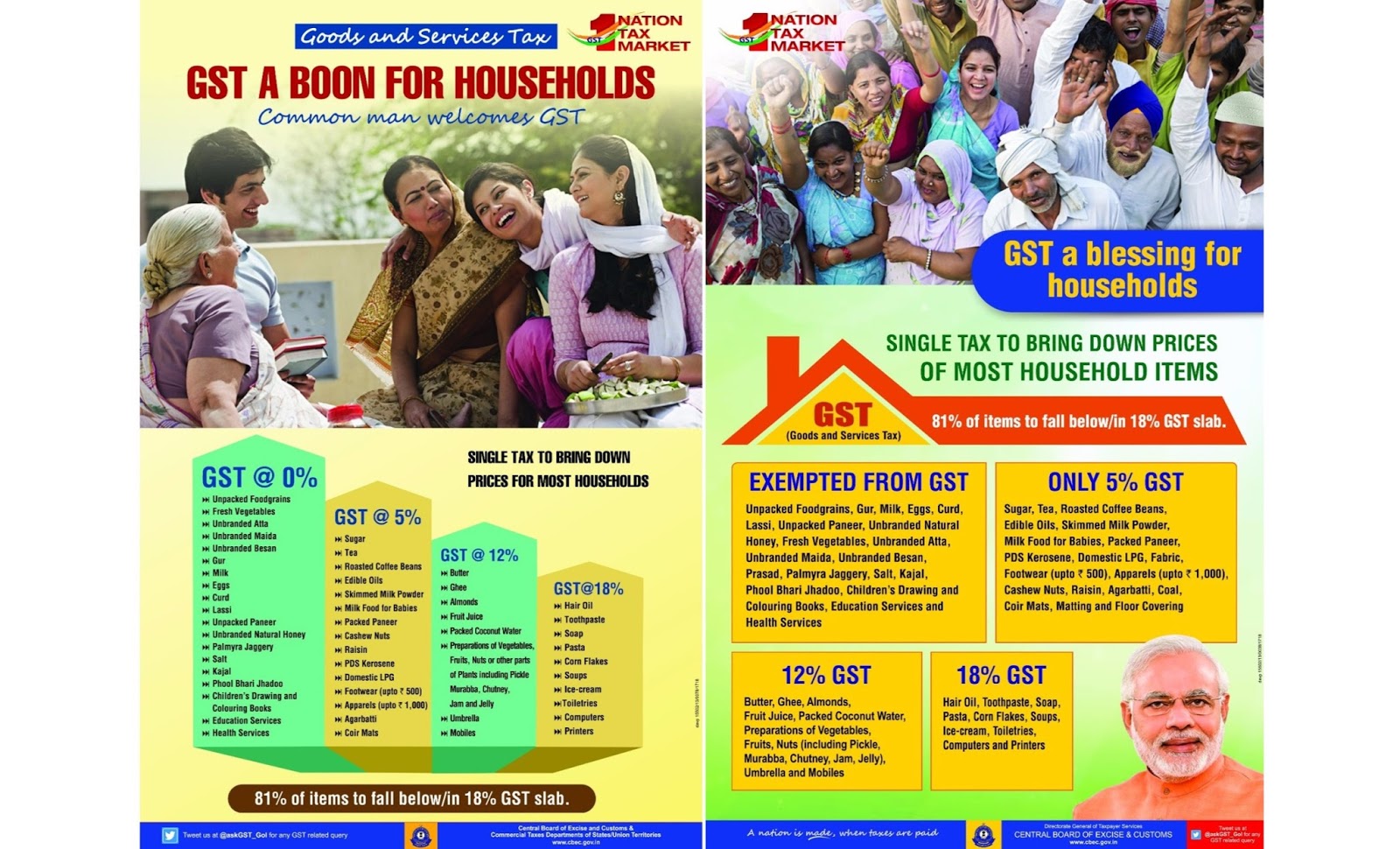
It is VAT which levied on goods and service tax. But even VAT is also unable to stop the cascading effect of taxes. That's why GST had been come in the scenario to eliminate the cascading effect and lowers the overall cost of goods and service to the consumer. It is simply equivalent to the consumption tax which will be levied on goods and services only (as its name suggests). In this GST regime imports will be subject to this while exports becomes zero rated.
It is also expected that it will broad the tax base structure of India, promotes one nation one market theory, boost Make in India program and thus boosting the economy. It will also provide reduction in the compliance cost like the ones on entry tax and e-commerce taxation existing today. It also alleviate for keeping multiple records and filing returns of multiple taxes which also provides the less effective cost to trades. For dispute redressal mechanism GSTN portal must be used.

In terms of Government revenues, when we have broad tax base structure and improving taxpayer compliance then it automatically improves the tax to GDP ratio which also improves our ranking in 'Ease of Doing Business Index'. As per the estimation of GoI after implementing the GST there must be an additional growth of 0.9% -1.6% in GDP. When we have improved taxpayer compliance then it also boost the small taxpayers. Under GST SMSE's(Small medium sector enterprises) will got some benefits like the small taxpayers whose turn over is Rs.20 lakh (Rs. 10 Lakh for Northern- Eastern region, Sikkim, Uttranchal, Himachal Pradesh) need not to register under the GST regime.


Major Impacts of GST

  • Improving the govt. tax structure and services
  • Lowers the corruption or red tapism
  • Generate more employments which is most demanding and challenging part.

How do we become more developed? Answer is simple - by removing poverty. But after the 1947 political freedom, our policies, our govt., our administration is unable to bring that reforms. That's why present govt. use the slogan of ''Sabka Sath Sabka Vikas''. Becuase govt. has realised that removing poverty from India is not their cup of tea alone. The majority of people have to come forward and bring a reforms regarding this context. 
So next question is how we can remove poverty? Again answer is very simple- by generating skills, giving proper training and bringing a manufacturing revolution. But most of our entrepreneurs doesn't want to setup a factories in India due to the complex taxation system. Apparel manufacturers will like to setup their factories in Bangladesh (already have GST structure) rather than India. Flipkart itself had their HQ in Singapore due to land acquisitions problems.

With the advent of GST it will create more factories ---- create more business ---- create more jobs ---- create more competition in the market ---- create more taxes to government ---- create more revenues ---- hence lower the prices ---- lower the bank rates for micropreneur.

Simply saying when govt. create more money through GST then it left with only two options. First to have less other tax rates or to create more services. That's how an economic cycle work. It will also create more transparency in the taxation system which automatic lead to lower the corruption in the system. 


How GST works??


Here are some links for those who wants to get more information about its pros or cons.