Sunday, 2 July 2017

GST- The mission continues

Introduction


Any civilisation from ancient India to modern India governed by its State machinery. Taxes forms a major part to run that machinery. Perhaps that's why the king, landlord, feudal landlords, government taxed their subjects. Why do govt. levy tax? Answer is simple- to earn revenues and keep working for the benefits of citizen like running the development program and schemes. However in modern India with 132 crore + population, the tax system getting more complex and perverse over time. This new and bold reform will definitely make some reforms as the threat of deglobalisation entered the world politics scenario. For understanding GST (Goods & Service Tax) let's first understand the various taxes in India.


Taxes


It is the amount charged by the govt. on product, income and activity. It become direct tax if it is levied directly on income of a person or of a company. But if it is levied on the price of good and service then it called as indirect tax.
If a tax levied on every sale made then it is called as sales tax. When tax levied at each step of the process - from manufacturer to distributor to wholesaler to retailer to customer then it is called cascading effect of tax. In VAT (Value added tax), the rate should be uniform.


Why GST??


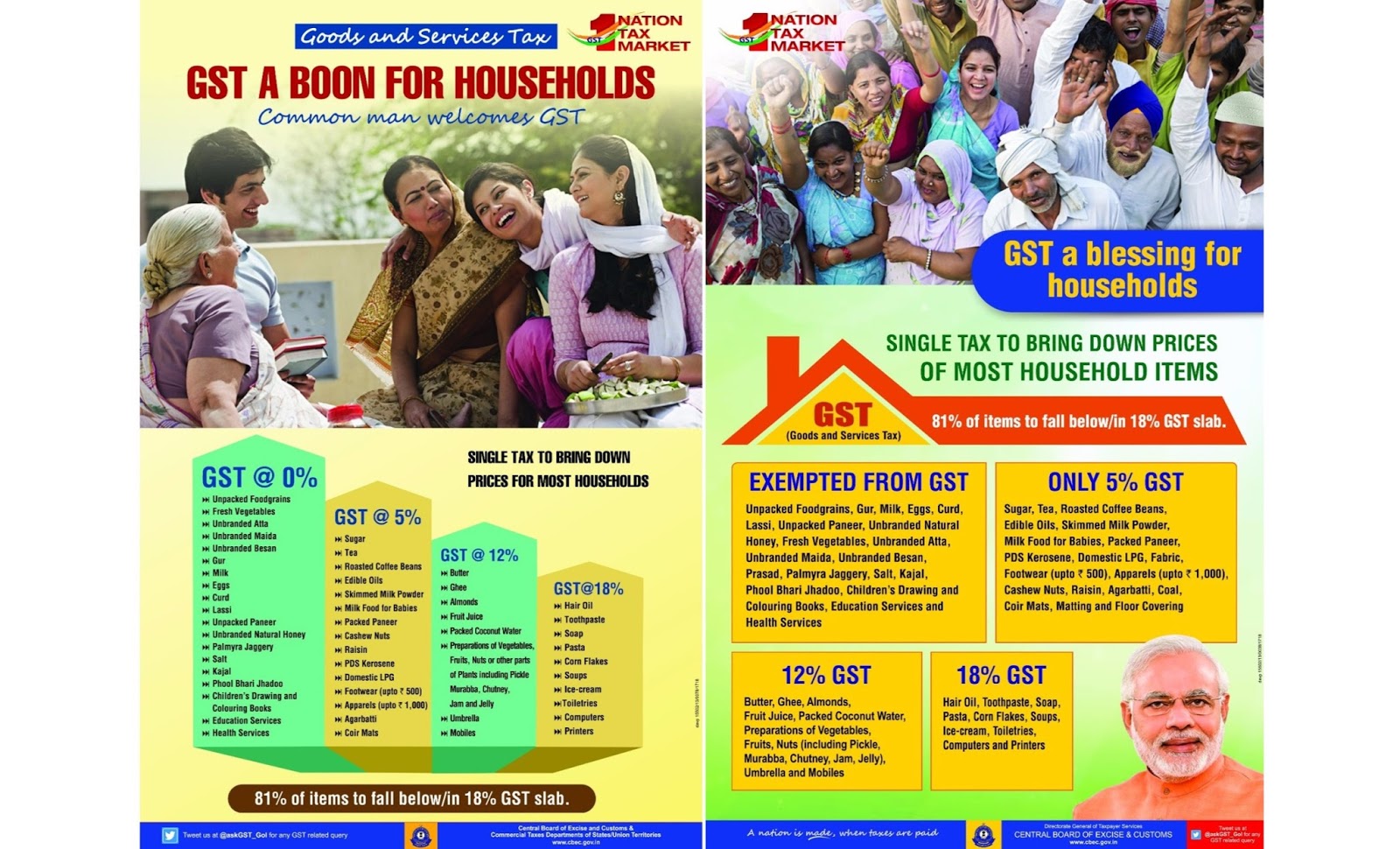
It is VAT which levied on goods and service tax. But even VAT is also unable to stop the cascading effect of taxes. That's why GST had been come in the scenario to eliminate the cascading effect and lowers the overall cost of goods and service to the consumer. It is simply equivalent to the consumption tax which will be levied on goods and services only (as its name suggests). In this GST regime imports will be subject to this while exports becomes zero rated.
It is also expected that it will broad the tax base structure of India, promotes one nation one market theory, boost Make in India program and thus boosting the economy. It will also provide reduction in the compliance cost like the ones on entry tax and e-commerce taxation existing today. It also alleviate for keeping multiple records and filing returns of multiple taxes which also provides the less effective cost to trades. For dispute redressal mechanism GSTN portal must be used.

In terms of Government revenues, when we have broad tax base structure and improving taxpayer compliance then it automatically improves the tax to GDP ratio which also improves our ranking in 'Ease of Doing Business Index'. As per the estimation of GoI after implementing the GST there must be an additional growth of 0.9% -1.6% in GDP. When we have improved taxpayer compliance then it also boost the small taxpayers. Under GST SMSE's(Small medium sector enterprises) will got some benefits like the small taxpayers whose turn over is Rs.20 lakh (Rs. 10 Lakh for Northern- Eastern region, Sikkim, Uttranchal, Himachal Pradesh) need not to register under the GST regime.


Major Impacts of GST
  • Improving the govt. tax structure and services
  • Lowers the corruption or red tapism
  • Generate more employments which is most demanding and challenging part.

How do we become more developed? Answer is simple - by removing poverty. But after the 1947 political freedom, our policies, our govt., our administration is unable to bring that reforms. That's why present govt. use the slogan of ''Sabka Sath Sabka Vikas''. Becuase govt. has realised that removing poverty from India is not their cup of tea alone. The majority of people have to come forward and bring a reforms regarding this context. 
So next question is how we can remove poverty? Again answer is very simple- by generating skills, giving proper training and bringing a manufacturing revolution. But most of our entrepreneurs doesn't want to setup a factories in India due to the complex taxation system. Apparel manufacturers will like to setup their factories in Bangladesh (already have GST structure) rather than India. Flipkart itself had their HQ in Singapore due to land acquisitions problems.

With the advent of GST it will create more factories ---- create more business ---- create more jobs ---- create more competition in the market ---- create more taxes to government ---- create more revenues ---- hence lower the prices ---- lower the bank rates for micropreneur.

Simply saying when govt. create more money through GST then it left with only two options. First to have less other tax rates or to create more services. That's how an economic cycle work. It will also create more transparency in the taxation system which automatic lead to lower the corruption in the system. 


How GST works??


Here are some links for those who wants to get more information about its pros or cons.

Sunday, 8 January 2017

The Internet of Things

The Internet of Things (IoT) is a term that discussed for our future as well as for our present too. This is a revolutionary thing that changed our life completely. In the upcoming fourth Industrial Revolution, IoT will be a key component for every big companies of every sector. It's a change from Anytime, Anywhere & Anybody- to- Anything.

Definition


IoT creates a world where physical objectives seamlessly integrated into information network and can easily became a part of business processes. The concept is very simple. Its about the connecting devices to the Internet with an ''On or Off Switch''. 
It refers to a wireless connection between objects enables the Internet to reach out into real world of physical objects. For example- adjusting your heating via an app can gather a useful data. That's why Google had purchased the Nest (Thermostat Company).

How it works!!


IoT is a scenario where humans, animals or objects are given a unique sensors and identifiers. They can transfer data over a network without human-to-human or human-to-machine contact. Three things made it possible for its working- Micro Electro-Mechanical Systems, Wireless Technology and Internet which finally create a machine-to-machine interface. Sensors combined with smartphones, will allow for more efficient energy networks (across cities and in your homes), reduced congestion and improved transport, multi use buildings etc. 
Houses, offices, factories and public buildings could all generate electricity from renewable sources. Sensor would then coordinate the distribution and storage of this power, making whole systems cleaner, more efficient and more stable. For example- South Korea's Smart City-Songdo and Grogniem in Holland use internet enabled dustbins that saves money regularly. 

Internet to Datanet


IoT provides real-time, location specific information, environmental & infrastructure activities information. All this creates a net of data which further be monitored and available to public also. This huge data created by IoT converts in 'Big Data' which will not be an easy task to handle by normal data methods and tools.


So It's Great then??


IoT has potential to make our lives better. It has efficient heating systems that could save us money, transport apps could save our time, new electric grid system could help to save the planet. But for its greatness then the answer is a NO, because it has some kinds of challenges associated with it. 
First- Social Challenges:
(a) Each connected device in theory become a risk & possible target for hackers. Like the criticisms of Demonetisation is about the security of the data. That's why Govt. had brought CERT- Computer Emergency Response Team.
(b) Privacy of individual is at stake at multiple levels. Consider a Smart Electricity Meter that knows your electricity use & typical times you are at home. All this could be available to hackers. This is called as privacy breachness.
(c) Machine guiding every aspect of our human lives. Simply saying we are addicted to machines. In other terms, we are became slaves of machines. According to me, Smartphones with all time on Internet devices make the person of less scientific temper because operating a smartphone is a process-driven system. The individual had not put his/her mind to operate it. He/she had to follow some steps, that's why I usually says ''The Smarter is your phone, the more dumber you are''.

Second - Governance Challenges: IoT will require legislation for security purpose of data. For this some amendments had to be brought in the constitution for preserving the Fundamental Right of an individual. Entire new governance structure will be needed. (The biggest challenge for PM Modi for his Smart City Project) Huge growth of electronic waste & environmental issues.

Good Bye to Pure Manufacturing


Earlier, great manufacturing meant making of great physical goods. A huge change is now that physical products are being stuffed with sensors & are being connected to Internet. So products becomes Products + Services (Change No.1).
Services run on information and information needs an operating system (Change No.2). So if a giant software & Internet company controls this operating system then manufacturers will lose all their edge. This transition had happened earlier when PC & Handsets makers lost their edge to windows or IOS/Android (Creative Destruction Theory by Schumpeter). 
The self-driven cars of Google moon shot venture Alphabet, Amazon Web Services and finally the Boss of Manufacturing - Germany's new program of ''Industrie 4.0'' are its fine examples. In upcoming fourth Industrial Revolution will be full of most amazing things like IoT and by the end of 2030 it will be a completely different world. 

http://www.bbc.com/news/technology-23757738- Link of Songdo Smart City in South Korea

Video of IoT- A must Watch


Sunday, 25 December 2016

Global Issue of Population

In the world today there is various places with a varieties of mindsets of peoples with their corresponding languages. Each place has its own symbolism and cultural creativity. The term 'Modern Homo Sapiens' emerged around 50,000 years ago. Its subspecies is called as 'Modern Homo Sapiens Sapiens'.


Facts & Figures

At present the total number of humans alive today is around 7 billion. The total number of humans ever born is 108 billion. So basically, at present there is roughly about 6.5% of total human beings alive today. If we see a history profile of population, rate of growth of population decreasing due to global 'demographic transition'. 

Presently the key issues with developed countries is about the ageing of populations. For example in America, there is no social security benefits left by the time the people reach their retirement. The declining profile of birth rates suggest that fewer young people left to pay for the care of elderly. That's exactly happens in almost every countries of Europe and Japan.


Demographic Dividend

Younger people are usually considered as economic gift for countries. When the working-age- population (15 to 64 years) is larger than the non- working age population group, then there is usually a boost in economic activity, productivity and many such things. China is the best example of this part. 

Now this 'demographic dividend' will become 'demographic disaster' due to lack of jobs among young age population. It also worsened the economic aspect of any country. For example Sub-Saharan Africa is already one of the youngest regions in world & youth unemployment is high. Brazil economic activity is adversely collapsed due to 'demographic disaster'.
So if its is assume that there is only 100 people in the world then the ratio of male over female is 50 : 50. Out of 100 peoples, 26 will be children and 74 adults. In terms of literacy - 83 will be literate and 77 has their own houses. From religious outlook, there would be 33 Christians, 22 Muslims, 14 Hindus, 7 Buddhists, 12 others and 12 atheist. 


India

In context of India, some pluses and corresponding some minuses are associated. India is 7th largest nation by landmass occupying 2.4% of world land & second largest by population supporting 17.4% of world population and still growing.Out of which 68% are rural population still now.  By the end of 2050, India will have a population of around 165 crores. Now this create a big difference and a big challenge too. Women empowerment is not yet done as compared to other countries which suggest the key issue of population in India.

But India have a large working age population group and more than 50% people are below the age of 35 years. It will be also predicted that by the end of 2020, Indian average age will be 32 years of age which is definitely be a 'demographic dividend' for us.  


Globally, Japan has become the oldest nations of world having an average of around 46 years with 23% of population over 65 years.